Showing posts with label Kate Farrell. Show all posts

Wednesday, 8 March 2023

For International Women's Day let's celebrate 3 women authors published by Parallel Universe Publications

SAMANTHA LEE - Author of Childe Rolande

Samantha Lee began writing while she was still a professional performer. Her output is as diverse as it is prolific, covering both fact and fiction and including novels in the sci-fi and dark fantasy genres, self-development and exercise books, short stories and articles, TV series and movie screenplays, literary criticism and poetry. Her work has been translated into French, Dutch, Spanish, Swedish, Italian, German, Croatian, Greek and Chinese.

Of her eighteen books to date five feature in Scholastic's best-selling imprint 'Point Horror'. A regular columnist for 'Work-out Magazine' for five years and 'The Marbella Times' and 'Viva Espana' for three, she has had over two hundred articles published worldwide. Seventy-eight of her quirky short stories have featured on radio and TV as well as in various best-selling anthologies and popular magazines. A collection of her short stories is now available under the title 'Worse Things than Spiders'. Her black comedy screenplay 'The Gingerbread House' has been sold twice, first to 'Niagara Films' then to 'Random Harvest Productions'.

Sam has taught creative writing workshops in libraries and at literary Festivals all over Britain and acted as Master of Ceremonies at Fantasycon 11. In the Year of Literature she was writer in residence during the 'Welcome to my Nightmare' weekend in Swansea. In 2008 her team 'The Frankensteins' won both the jury and audience awards in the '24 hour challenge' at the Marbella International Film Festival for their five minute short 'Death Dancers'. Sam wrote the screenplay and played the villain, Mamma Sam, a loan-shark with an eyepatch and a bad attitude. She was a jury member at Malaga University's 'Fancine' Fantasy Film Festival the year the jury was chaired by Antonio Banderas.

She writes a romance strand under the pseudonym Petra Webb. Her latest romantic thriller set in southern Spain is 'The Marques'.

Website: www.samanthaleehorror.com

amazon.co.uk

amazon.com

KATE FARREL - Author of And Nobody Lived Happily Ever After

Kate Farrell lives in Edinburgh. She was an actress for over thirty years, in a career that spanned everything from Chekhov to Chucklevision. As she is pathologically indisposed to describe a happy ending, she now principally writes ‘contes cruels’ wherein bad things happen to bad people; sometimes the innocent suffer too. Several of her stories have been published: in Charles Black’s Black Books of Horror, Paul Finch’s Terror Tales, The Screaming Book of Horror and Best British Horror 2014, both edited by Johnny Mains. Kate’s debut novella My Name is Mary Sutherland was published by PS in 2014. And Nobody Lived Happily Ever After for Parallel Universe Publications is her first collection of short stories. Two of her stories, Mea Culpa and My Name Is Mary Sutherland, have won awards, also one sonnet and one haiku. The opening chapter of the novel Or The Cat Gets It won the Linen Press award for their Beginnings Competition. For further information check out the website: mynameiskatefarrell.com and for updates try her Facebook page: mynameiskatefarrell.

"What distinguishes Kate Farrell’s work is the extraordinary accuracy and vividness with which she sets up her situations. She has an eye for detail and an outstanding ear for the way people think and speak. It is far from fanciful to see this at least partly as the product of her experience as an actress. In the theatre, a natural faculty for observing one’s fellow human beings is trained and honed. Listen to the narrator of “Waiting”. If you don’t know someone like that personally, you will have certainly heard her talking just behind you on a bus at some time. The intonation, the accent, the understanding, and the lack of it, are all so true to life. But the people Farrell evokes are not all from one social stratum, or one nation. Here is an ancient and corrupt Irish Priest (“The Way the Truth and the Life”), here is the wife of a notorious Argentinean dictator (“Las Cosas Que Hacemos por el Amor”), or the two Spanish schoolchildren in “The Efficient Use of Reason”, and they are all done with the same conviction, the same ruthless accuracy. Farrell’s eye is not heartless, but it is unclouded by any kind of sentimental affectation; her horrors emerge from what we sometimes call the commonplace. Very occasionally she touches on the supernatural, but when she does she does it superbly as in one of my favourites among her stories “A Murder of Crows” which shows that she can do an uncanny rural atmosphere with grim poetry as well as anyone. It is the gift of every worthwhile writer in this genre to make us realise that just beneath the surface of the banal and ordinary, there yawn great abysses of wonder and terror. I don’t know quite why this realisation, in the hands of a writer like Farrell, should be so thrilling, enjoyable even, but it is. There is not a dull page, not a dull sentence in And Nobody Lived Happily Ever After." From Reggie Oliver 's introduction to And Nobody Lived Happily Ever After

Amazon.co.uk 

Amazon.com   


JESSICA PALMER - author of Fractious Fairy Tales and Other Visions of Heaven and Hell

Jessica Palmer has had 30 books published, both fiction and nonfiction. Her novels – horror, fantasy and science fiction – were released by Pocket Books in the United States and Scholastic in the United Kingdom. She has written two textbooks about Native American history, which were published by McFarland, and an encyclopedia of natural history released by Harper Collins’ label Element Books and later by Thorson in the UK.
Palmer has also written ten science-and-technology manuals on the topics of explosives and radiation. These were distributed globally. It was this work that brought her to Great Britain in 1988.
The daughter of a professional clown, Palmer refers to her switch to writing fiction as an exercise in damage limitation. She taught classes and conducted workshops on creative writing and publishing at North Shropshire College in Whitchurch, Stanmore College and the Islington Arts Factory in London.
As a journalist, Palmer won awards in New Mexico and Texas for writing features, public service and breaking news – the most recent in 2013. Palmer has also written satirical columns for newspapers, including “A Slice of Life” and “How to Make Love to your Personal Computer.”
Her two loves are writing and animals. She started a nonprofit in Kansas for wildlife rescue and has held a wildlife rehabilitation permit since 2002.


Amazon.co.uk

Amazon.com  


amazon.co.uk 

amazon.com

Tuesday, 6 February 2018

Women in Horror Month - Kate Farrell

Artwork: Vincent Chong
Kate Farrell was the first female writer to have a collection of her stories published by Parallel Universe Publications. And Nobody Lived Happily Ever After was published in December 2015, with an introduction by her old friend, actor, writer and artist, Reggie Oliver. We can't do better than reprint here what he had to say about Kate:

"I first met Kate Farrell on Monday March 5th 1984 at a place called Petyt Hall, hard by Chelsea Old Church in London. I know this for a fact because I kept a diary, and for that matter still do. It was the first day of rehearsals for a major national tour of Garrick and Colman’s play, The Clandestine Marriage in which we were both playing supporting roles to such theatrical luminaries as Joyce Redman, Roy Kinnear and Sir Anthony Quayle. Kate Farrell, or Kate David as she was then, was a bright young character actress with a gift for friendship and a sharp, humorous eye for the follies of her fellow actors. I, of course, had no idea then that I was encountering a future mistress of macabre fiction, the Countess of the conte cruel; but I thought I could detect in her a good sport, a “trouper” to use the old theatrical term, and I was right. Did she herself at the time have any intimations of her great literary destiny? I think not.

During the long tour of a play indelible friendships are forged, and sometimes indelible enmities. With Kate, happily, it was the former. 1984 was the year that Margaret Thatcher took on the miners and, as we made our way round England, the head of the company Anthony Quayle, expressed the pious hope that our tour to all four corners of the nation would help heal the great “North-South divide” that was being much talked about at the time. How Sir Anthony imagined that the performance of an 18th century comedy about aristocratic misalliances could oil the troubled waters of class hatred I do not know. Kate and I both thought that the idea was b – well, shall we say, a little far-fetched. We shared a distrust of that mixture of grandiosity, sharp practice and slightly glib bonhomie of which Sir Anthony was capable. A group of us, including Kate and myself, shared digs whenever we could. There were parties and laughter and gossip; we heard reports of Thatcher’s war with Scargill and the miners, but it seemed a world away.
After the tour there was a West End run at the Albery Theatre and my friendship with Kate continued when that came to a close. Over the years we kept in touch. I began to devote more time and effort to writing. The theatre is a fickle mistress and life took both Kate and I in different directions. One day, perhaps, she will tell us of her experiences with the infamous Chuckle Brothers, but at some stage show business ceased to beckon for her as well. She too began to write and she sent me some of her stories.
I am generally wary of commenting on other people’s unpublished manuscripts. What if they are no good? How does one gently tell a good friend that the writing of fiction is not for them? The stories Kate sent me were “His Family”, “Mea Culpa” and an early version of “My Name is Mary Sutherland.” I read them and I must admit my first reaction was one of immense relief: they were good, really good. No disingenuous words of faint praise were needed. I was impressed by the extraordinary assurance of the writing. Purple passages, wearisome clichés, vague and inconsequential digressions, indeed any sign of the amateur, all were entirely absent from her engrossing narratives. I should have known: Kate had always been the most professional of actresses; she was bound to be professional in whatever she took up.
But there was something much more important even than professional competence in her writing. She had a voice: crisp, shrewd, unsparingly honest, and rather elegant, despite the decidedly macabre subject matter. The people in her stories lived: they were vivid, recognisable; you might be unfortunate enough to meet them. You heard their voices and they seemed disturbingly familiar. The story telling was often uncommonly ingenious and surprising, as in “Mea Culpa,” but the ingenuity was not just for show; it always had a purpose. I advised Kate to send some of her stories to Charlie Black, for inclusion in one of his splendid Black Book of Horror anthologies. He accepted them without hesitation, as I was sure he would, and the rest, as they say, is her story.
As you have probably just acquired this book what more need I say, really, except that you are in for an exceedingly entertaining and thought-provoking time from one of the most accomplished and original writers of macabre fiction alive today? If by any chance, you have not yet bought it, and are browsing through its pages, then what are you doing reading this introduction? You just have to go to the first paragraph of any of the stories here, and you will be hooked, but before you do, save yourself the discomfort of reading this book while standing up and probably pressed for time in a draughty bookshop. Buy the thing – it is exceptionally reasonably priced – put it in your pocket, go back home, make a cup of tea (or something stronger if you prefer) settle yourself in a favourite armchair and start reading.
You have done that? Congratulations! My job is done. But just in case you need a little further encouragement, let me say this. What distinguishes Kate Farrell’s work is the extraordinary accuracy and vividness with which she sets up her situations. She has an eye for detail and an outstanding ear for the way people think and speak. It is far from fanciful to see this at least partly as the product of her experience as an actress. In the theatre, a natural faculty for observing one’s fellow human beings is trained and honed. Listen to the narrator of “Waiting”. If you don’t know someone like that personally, you will have certainly heard her talking just behind you on a bus at some time. The intonation, the accent, the understanding, and the lack of it, are all so true to life. But the people Farrell evokes are not all from one social stratum, or one nation. Here is an ancient and corrupt Irish Priest (“The Way the Truth and the Life”), here is the wife of a notorious Argentinean dictator (“Las Cosas Que Hacemos por el Amor”), or the two Spanish schoolchildren in “The Efficient Use of Reason”, and they are all done with the same conviction, the same ruthless accuracy. Farrell’s eye is not heartless, but it is unclouded by any kind of sentimental affectation; her horrors emerge from what we sometimes call the commonplace. Very occasionally she touches on the supernatural, but when she does she does it superbly as in one of my favourites among her stories “A Murder of Crows” which shows that she can do an uncanny rural atmosphere with grim poetry as well as anyone. It is the gift of every worthwhile writer in this genre to make us realise that just beneath the surface of the banal and ordinary, there yawn great abysses of wonder and terror. I don’t know quite why this realisation, in the hands of a writer like Farrell, should be so thrilling, enjoyable even, but it is. There is not a dull page, not a dull sentence in And Nobody Lived Happily Ever After.
And now, I suggest you waste no further time on studying this introduction, and embark at once on the seriously exciting business of reading Kate Farrell.

Reggie Oliver"


Thursday, 1 February 2018

Women in Horror Month

As it's Women in Horror Month, a reminder of two great books published by Parallel Universe Publications: Jessica Palmer's Other Visions of Heaven and Hell, and Kate Farrell's And Nobody Lived Happily Ever After. A second collection of Jessica's stories, Fractious Fairy Tales, will be published by PUP later this month.

Wednesday, 1 February 2017

Parallel Universe Publications celebrates "Women in Horror Month"

To celebrate "Women in Horror Month" Parallel Universe Publications is making this special offer for the whole of February: buy either Kate Farrell's And Nobody Lived Happily Ever After or Jessica Palmer's Other Visions of Heaven and Hell directly from us and you can choose one of the following bumper anthologies free: Things That Go Bump in the Night, Classic Weird, or ClassicWeird 2.


"What distinguishes Kate Farrell’s work is the extraordinary accuracy and vividness with which she sets up her situations. She has an eye for detail and an outstanding ear for the way people think and speak. It is far from fanciful to see this at least partly as the product of her experience as an actress. In the theatre, a natural faculty for observing one’s fellow human beings is trained and honed. Listen to the narrator of “Waiting”. If you don’t know someone like that personally, you will have certainly heard her talking just behind you on a bus at some time. The intonation, the accent, the understanding, and the lack of it, are all so true to life. But the people Farrell evokes are not all from one social stratum, or one nation. Here is an ancient and corrupt Irish Priest (“The Way the Truth and the Life”), here is the wife of a notorious Argentinean dictator (“Las Cosas Que Hacemos por el Amor”), or the two Spanish schoolchildren in “The Efficient Use of Reason”, and they are all done with the same conviction, the same ruthless accuracy. Farrell’s eye is not heartless, but it is unclouded by any kind of sentimental affectation; her horrors emerge from what we sometimes call the commonplace. Very occasionally she touches on the supernatural, but when she does she does it superbly as in one of my favourites among her stories “A Murder of Crows” which shows that she can do an uncanny rural atmosphere with grim poetry as well as anyone. It is the gift of every worthwhile writer in this genre to make us realise that just beneath the surface of the banal and ordinary, there yawn great abysses of wonder and terror. I don’t know quite why this realisation, in the hands of a writer like Farrell, should be so thrilling, enjoyable even, but it is. There is not a dull page, not a dull sentence in And Nobody Lived Happily Ever After." From Reggie Oliver 's introduction to And Nobody Lived Happily Ever After

Contents are:
Introduction by Reggie Oliver
Mea Culpa
Helping Mummy
A Murder of Crows
No Junk Mail
All in a Row
Dad Dancing
The Way and the Truth and the Life
My Name is Mary Sutherland
The Efficient Use of Reason
How I Got Here
His Family
The Sands are Magic
Once Upon a Time
A. Reeves Tale
Las Cosas Que Hacemos por El Amor
Peacock Blue Dress
Alma Mater
Waiting

Mea Culpa was first published in The Eighth Black Book of Horror, 2011
His Family was first published in The Ninth Black Book of Horror, 2012
Dad Dancing was first published in The Tenth Black Book of Horror, 2013
Helping Mummy was first published in The Screaming Book of Horror, 2012
The Sands are magic was first published in Terror Tales of the Seaside, 2013
Waiting was first published in Kitchen Sink Gothic, 2015
Alma Mater was first published in The Eleventh Black Book of Horror, 2015


Jessica Palmer has had 28 books published, both fiction and nonfiction. Her novels – horror, fantasy and science fiction – were released by Pocket Books in the United States and Scholastic in the United Kingdom. She has written two textbooks about Native American history, which were published by McFarland, and an encyclopedia of natural history released by Harper Collins’ label Element Books and later by Thorson in the UK.
Palmer has also written ten science-and-technology manuals on the topics of explosives and radiation. These were distributed globally. It was this work that brought her to Great Britain in 1988.
The daughter of a professional clown, Palmer refers to her switch to writing fiction as an exercise in damage limitation. She taught classes and conducted workshops on creative writing and publishing at North Shropshire College in Whitchurch, Stanmore College and the Islington Arts Factory in London.
As a journalist, Palmer won awards in New Mexico and Texas for writing features, public service and breaking news – the most recent in 2013. Palmer has also written satirical columns for newspapers, including “A Slice of Life” and “How to Make Love to your Personal Computer.”
Her two loves are writing and animals. She started a nonprofit in Kansas for wildlife rescue and has held a wildlife rehabilitation permit since 2002.
Other Visions of Heaven and Hell are a series of sometimes inter-related stories about our ideas of Heaven and Hell, sometimes hilarious - sometimes horrific - but always entertaining.


Contents are:
Devil's Due
The Faithful
And now, a Word from our Sponsor
Heavenly Bodies
On the Wings of a Prayer
Fallen Angel
A Stitch in Time
Infinity
No Good Turn
Leap of Faith
Divine Comedy
Force of Habit
The Gates of Hell
Hell on Wheels
Cinderella Revisited
Last Laugh
Sisters
A Cold Day in Hell
Cheap Shots
What the Dickens
When Hell Freezes Over
Bad Medicine
Wrong Number
A Snowball's Chance
Devil Woman
To Be or Not
The King's Plate
An Afterthought
About the Author

"Last Laugh" was first published in Weirdbook #28, Autumn 1993, edited by W. Paul Ganley
"Cinderella Revisited" was first published in Weirdbook #29, Autumn 1995, edited by W. Paul Ganley
"What the Dickens" was first published in Substance Sept 1995


Classic Weird contains:
The Monster-Maker by W. C. Morrow
The Man Who Went Too Far by E. F. Benson
The Interval by Vincent O'Sullivan
The Doll's Ghost by F. Marion Crawford
The Dead Smile by F. Marion Crawford
The Ghost-Ship by Richard Middleton
The New Catacomb by Sir Arthur Conan Doyle
The Lost Stradivarius by John Meade Falkner
The House of the Dead Hand by Edith Wharton
A Wicked Voice by Vernon Lee
Phantas by Oliver Onions
This 298-page volume contains weird tales by some of the classic authors of the genre, including: 
J. Sheridan Le Fanu (An Account of Some Strange Disturbances in Aungier Street)
E. F. Benson (The Judgement Books) 
Vernon Lee (Oke of Okehurst)
Vincent O'Sullivan (When I was Dead)
Edith Wharton (The Eyes)
W. C. Morrow (A Story Told by the Sea)
Irvin S. Cobb (The Unbroken Chain)
Edith Nesbit (From the Dead)
Robert Murray Gilchrist (Witch In-Grain)
Amyas Northcote (The Downs)
J. H. Riddell (The Uninhabited House)

Things That Go Bump in the Night edited by Douglas Draa and David A. Riley is now available in trade paperback from Parallel Universe Publications. 365 pages long, this bumper volume contains 19 classic weird stories by Sir Hugh Clifford, Edward Lucas White, William Hope Hodgson, George Allan England, F. Marion Crawford, Frederick Marryat, E. F. Benson, W. C. Morrow, Amyas Northcote, M. P. Shiel, Lord Dunsany, Perceval Landon, Robert E. Howard, G. G. Pendarves, Henry Brereton Marriott Watson, Irvin S. Cobb, Huan Mee, Abraham Merritt, Nictzin Dyalhis, and Edith Wharton.

The Ghoul Sir Hugh Clifford
The House of the Nightmare Edward Lucas White
The Voice in the Night William Hope Hodgson
The Thing from Outside George Allan England
For the Blood is the Life F. Marion Crawford
The White Wolf of the Hartz Mountains Frederick Marryat
The Room in the Tower E. F. Benson
His Unconquered Enemy W. C. Morrow
The Late Mrs. Fowke Amyas Northcote
Xélucha M. P. Shiel
A Narrow Escape Lord Dunsany
Thurnley Abbey Perceval Landon
The Black Stone Robert E, Howard
Werewolf of the Sahara G. G. Pendarves
The Devil of the Marsh Henry Brereton Marriott Watson
Fishhead Irvin S. Cobb
The Black Statue Huan Mee
The Pool of the Stone God Abraham Merritt
The Sea-Witch Nictzin Dyalhis
The Lady’s Maid’s Bell Edith Wharton

Saturday, 21 November 2015

2016 Plans So Far for Parallel Universe Publications

Our twelth and final book for 2015
Kate Farrell's collection, And Nobody Lived Happily Ever After, will end this year for Parallel Universe Publications with its twelth book in as many months. Whether 2016 will be as productive it's too soon to say but we already have four books definitely lined up:
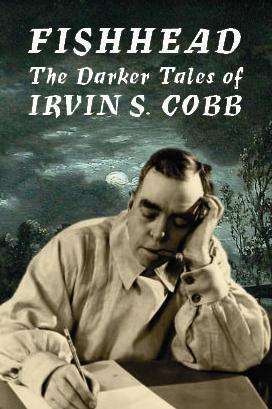
Fishhead: The Darker Tales of Irvin S. Cobb, which will be published initially as a limited edition hardback
England "B": Ninety Minutes of Hell by Richard Staines
Classic Weird 2, over 300 pages of classic stories
A Saucerful of Secrets by Andrew Darlington, tales of science fiction, science fantasy, and horror

We are also looking at another great collection of short stories which would bring the total up to five - not a bad start!

To be published 2016


Tuesday, 10 November 2015

Proof copy received for And Nobody Lived Happily Ever After by Kate Farrell


The proof copy for Kate Farrell's brilliant collection of short stories, And Nobody Lived Happily Ever After, arrived today. The book will be published by Parallel Universe, on December 1st.


Wednesday, 14 October 2015

And Nobody Lived Happily Ever After by Kate Farrell

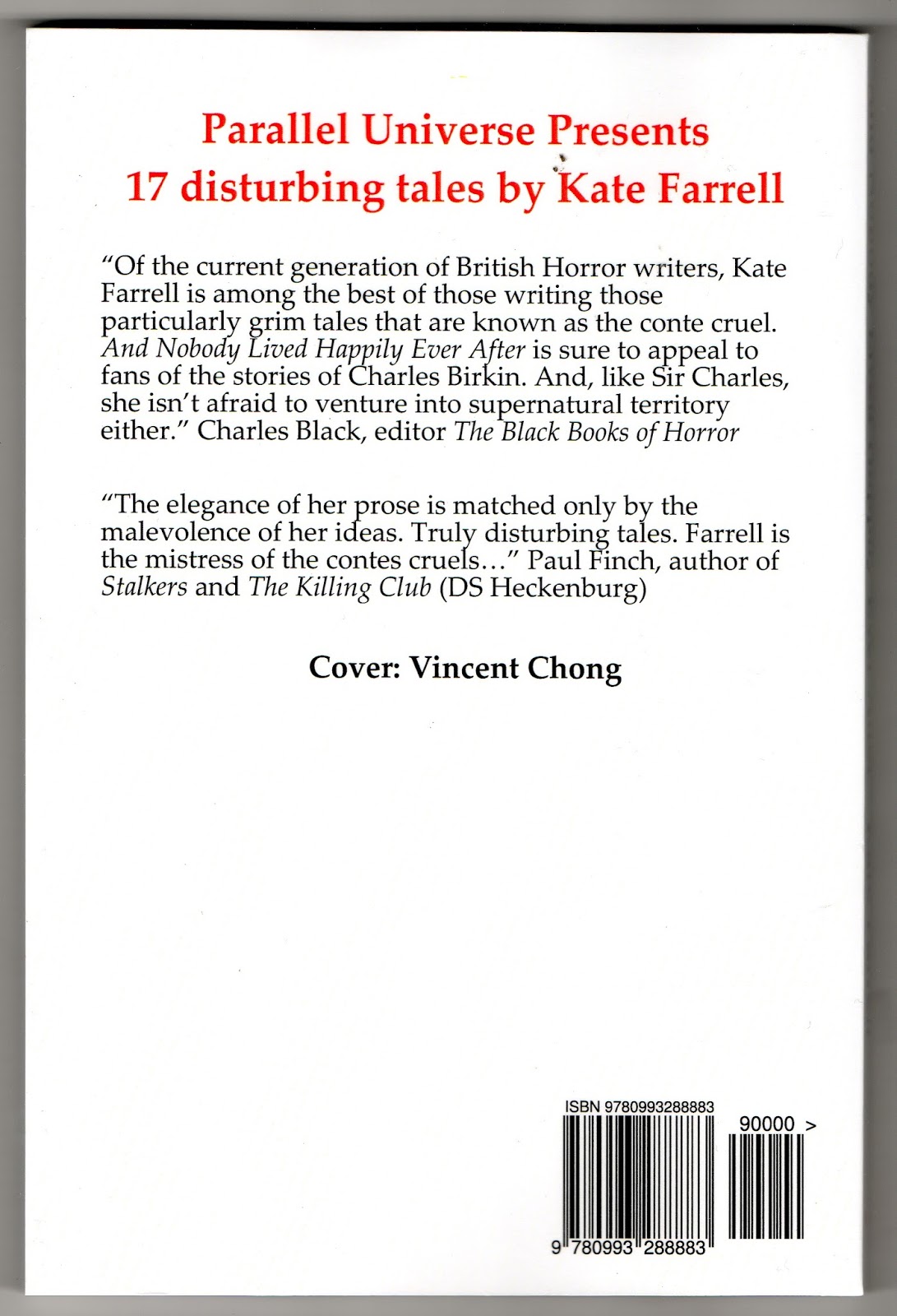
Cover Art: Vincent Chong
Busily proofreading the text for the forthcoming collection of short stories by Kate Farrell, And Nobody Lived Happily Ever After, which will be published by Parallel Universe Publications in December.
The cover is by the massively talented Vincent Chong.
The book will be published as a trade paperback and an ebook and will include seventeen highly disturbing stories.

Friday, 11 September 2015

Fishhead and Other Weird Tales by Irvin S. Cobb

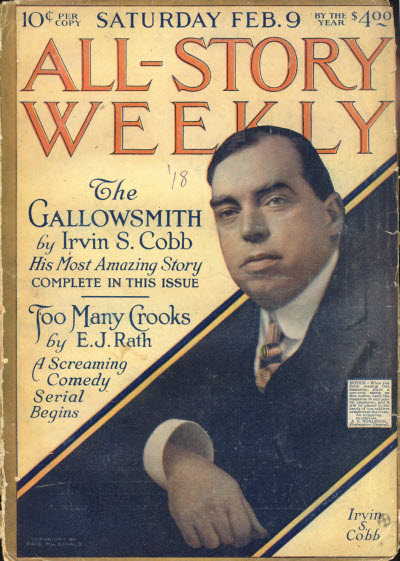
Besides working on getting Kate Farrell's collection of short stories into print - And Nobody Lived Happily Ever After - Parallel Universe Publications is also working on collecting together all of Irvin S. Cobbs' darker stories for the first time in one volume. Better known as a writer of humorous tales, this will show another side to him.
Two of his stories are known to have inspired H. P. Lovecraft himself. Cobbs' tale Fishhead (which PUP reprinted earlier this year in Things That Go Bump in the Night) gave rise to The Shadow Over Innsmouth. The Unbroken Chain helped to give Lovecraft the idea behind The Rats in the Walls.
The collection will be titled Fishhead and Other Weird Tales and will, hopefully, be published before the end of the year.